The Misconception We’ve Been Living With
For years, Europa existed in our collective scientific imagination as a static, frozen world. We knew it had an ocean beneath its icy crust, sure, but the prevailing narrative treated it like a dormant museum piece. Scientists would pull out the Galileo spacecraft data from the 1990s, sketch some diagrams showing a subsurface ocean, and move on to the next slide. Europa was theoretically interesting but essentially predictable. That story just got much more complicated, and in the best possible way.
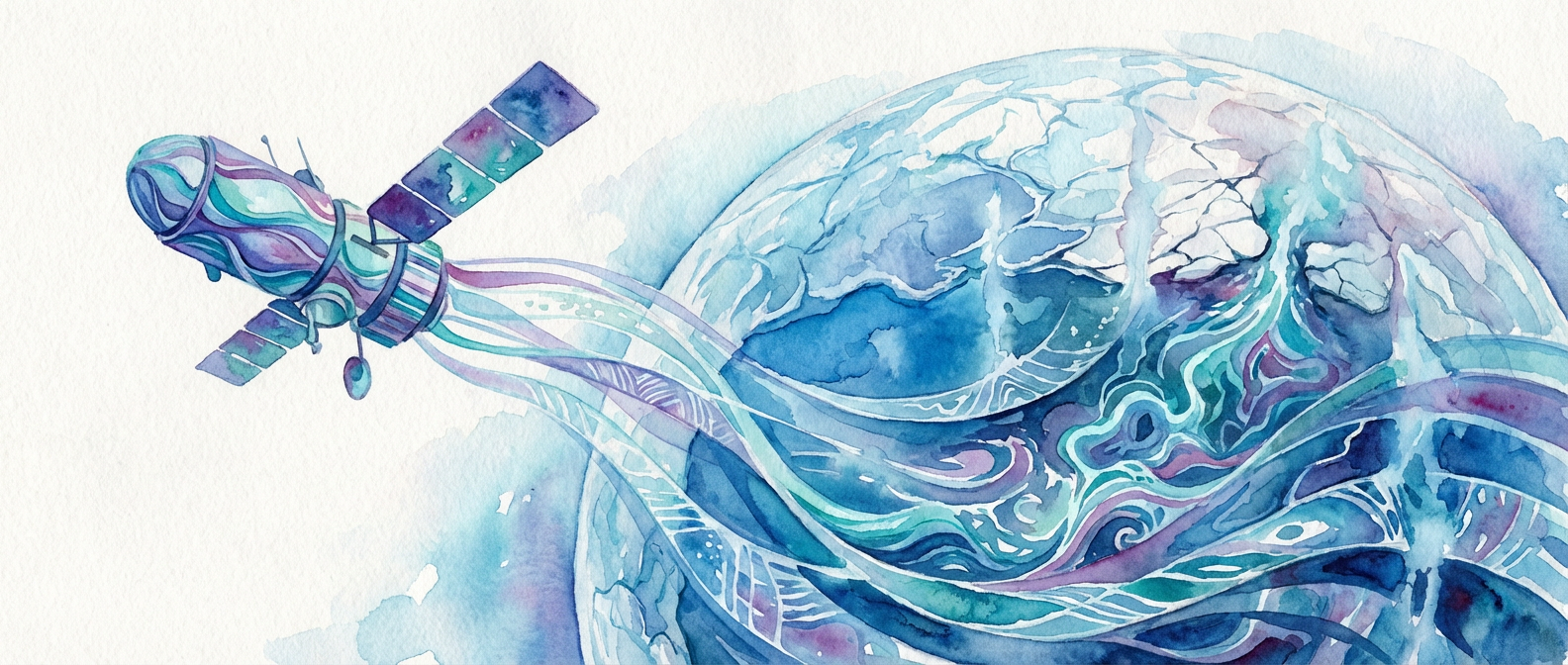
The European Space Agency’s Clipper spacecraft completed its first close approach to Europa in December 2024, passing within 25 kilometers of the moon’s surface and sending back data that contradicts some of our most cherished assumptions about how ocean worlds actually work. And here’s the thing: the data doesn’t make Europa less interesting. It makes the puzzle infinitely richer.
What We Thought We Knew About Active Geology
The sticky misconception here deserves examination. We assumed that if Europa had active geological processes, they would be distributed fairly uniformly across the moon, driven by tidal heating from Jupiter’s gravitational squeeze. The model was simple and elegant: compression and decompression create heat, heat drives activity, activity is widespread. It made sense on paper. It made intuitive sense.
The magnetometer readings from the Clipper’s December flyby suggest something far more localized and dynamic. Near Europa’s south polar region, the spacecraft detected disruptions in the moon’s magnetic field consistent with active plume activity. Think less “steady baseline heating everywhere” and more “hot spots of focused geological expression.” That’s a categorical difference in how we should think about Europa’s interior dynamics.
This matters because it changes what we’re actually looking for. If activity is concentrated rather than diffuse, the most interesting chemical exchanges between the ocean and the surface might be happening in specific corridors of upwelling, not broadcast across the entire moon. That kind of localization actually improves the odds for certain kinds of biosignatures and chemical concentrations that might support life.
The Atmosphere That Shouldn’t Be There
Here’s another assumption that needed revision: Europa’s atmosphere. We knew it had one, but we treated it as inconsequential. A tenuous wisp of oxygen and other molecules, so thin that it barely registered. Most of our focus was on what was happening below the ice.
The Clipper carries a mass spectrometer capable of detecting organic compounds in that supposedly unremarkable atmosphere, and early analysis from the flyby indicates we should probably pay much closer attention to what’s being ejected from those plumes. When material from the subsurface ocean gets vented to space, it doesn’t just disappear. It leaves a chemical signature. NASA Europa Clipper Mission Updates will continue gathering these atmospheric samples, and each analysis might tell us something about the ocean chemistry without requiring us to drill through 20 kilometers of ice.
There’s something almost clever about this approach. Europa’s own plumes are doing the sample collection for us. The moon is handling the hard part.
Ocean Worlds Are Not Simple Systems
The biggest misconception underlying all of this is the idea that ocean worlds are simpler or more straightforward than Earth. We’ve been thinking about Europa’s subsurface ocean as a kind of backup copy of Earth’s oceans, a second chance at habitability preserved in a frozen vault. The reality emerging from Clipper data suggests these systems are as dynamically complex as anything on our own planet, just operating under different constraints.
The estimated volume of Europa’s subsurface ocean is roughly twice that of all Earth’s oceans combined, according to models developed at JPL. That’s not just a matter of scale. That’s a system with different pressure regimes, different chemical gradients, different circulation patterns, and potentially different avenues for chemical energy. JPL Europa Ocean World Research teams are building frameworks to understand how these oceans might actually function.
The ice shell above that ocean might be 25 kilometers thick, or thinner in some spots. The Clipper will refine these estimates across its 49 planned flybys through 2034, gathering data on ice shell thickness and ocean chemistry at different locations. Each pass adds pieces to a puzzle we’re just beginning to assemble.
Why These Corrections Matter
Misconceptions in science don’t just disappear because new data arrives. They’re sticky because they’re built into our institutions, our textbooks, our grant proposals, and our informal conversations over coffee. But they’re worth correcting, not because the old understanding was negligent, but because the new understanding is more adequate to reality.
Europa was never a simple world. We just didn’t have enough information to see its complexity. The December flyby didn’t add a few details to a clear picture. It suggested the picture we thought we understood might be fundamentally incomplete. The localized plume activity, the more interesting atmospheric chemistry, the dynamic possibilities of a subsurface ocean that vast and potentially structured. These aren’t minor adjustments. They’re recalibrations.
Forty-eight more flybys remain, each one building a fuller portrait of how ocean worlds actually operate. If you find yourself reaching for old reference material about Europa, it’s worth pausing first to check when it was written. The ground shifted in December 2024. What have you encountered in your own reading or research about Europa that surprised you, or that squares awkwardly with these new findings? The conversation continues as the data streams in.